
Search for a tab of "Let There Be Peace On Earth"
Dulcimer Resources:TABS/Books/websites/DVDs
You might feel otherwise if you were trying to make a living as a songwriter.
The song is under copyright, so it is illegal to post free tab to the melody.
@jimws, the music to which @natebuildstoys links provides tab to play the chords, but not the melody, in the key of G. If you don't have a 1.5 you could just play that C chord as a 346 or 666. Another possibility would be to transpose everything to D and use the chords you are used to (D, Bm, G, etc.).
The song is under copyright, so it is illegal to post free tab to the melody. However, you can buy a "packet" from Tull Glazener that includes tab and a lesson on CD.
Hello Jim, I found this YouTube video showing one way to play it
This is one of my wife's favorite songs & she has asked me to play it. I've been unable to locate a tab. I would appreciate if anyone knows who may have tabbed it out.
I've used these for years...
I have cut smallish pieces of 2000 or 4000 grit sandpaper and glued them on picks to help with keeping them where they belong.
[quote="Ariane"]
@Alegre1 - Hi Alegre, I have just seen that I did not sent you an answer to your kind post...I am very happy that you like my last year's Appalachian waltz and look forward to this year`s International Appalachian Dulcimer Day - it is just such a lovely initiative from Robin
[/quote] [quote="Ariane"]
No worries, Ariane ... your music says everything!
I'm going to give this tip a good try out and pass on to others. Thanks for sharing.
Plasti-Dip is a similar product and might work too....
Thanks Wally. That's a good idea.
Ken
"The dulcimer sings a sweet song."
I have used "Liquid Electrical Tape" on a number of things to improve holding them or creating non-slip surfaces. The attached .PDF describes how I have used in to make picks harder to loose.
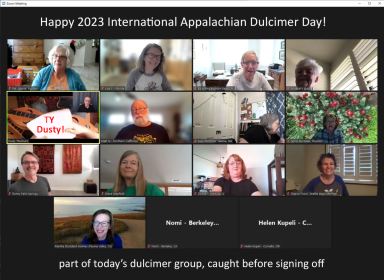
I cannot take credit for International Appalachian Dulcimer day-- it sprang out of a discussion of which I was just one of the voices here at FOTMD.
@Alegre1 - Hi Alegre, I have just seen that I did not sent you an answer to your kind post...I am very happy that you like my last year's Appalachian waltz and look forward to this year`s International Appalachian Dulcimer Day - it is just such a lovely initiative from Robin
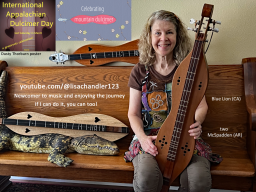
Yes, the 'official' International Appalachian Dulcimer Day in 2023 is Saturday 25 March. In a thread here at FOTMD, we landed on choosing the last Saturday in March as the day.
Thank you so much for this reminder!
The last Saturday of this month!
Ken, I assume you mean Richard Latker.
Richard is a member of FOTMD: @pristine2
Though he has not recently been active on this site, he might respond if you send him a private message here.
I seem to recall that Bruce Ford mentioned that he would not be saving or archiving the vast discussion forums of ED. I do recall reading Bruce's post about that and thinking Well that's a shame to lose all those years of discussion, but perhaps it's for the best anyway. I believe what was archived and made available were the Tab section, the Festivals section, and the Articles.
In any case, I think one would need a forum or php software framework and a hosted site in which to actually import/read/interpret an archived php forum. It's not like a text file that you can just open and read.
Dusty is right that you might try the internet Archive. However, it will be limited in terms of 'drilling down' into discussions from the past. You might not be able to get to all the replies or be able to search it the same way as a regular website. It won't function the same way as a real original forum.
Hope this helps.
You can test if it is sulfur based oxidation by doing this, (it works primarily on sterling but you can give it a try...........)
You need.......
a ceramic bowl lined with aluminum foil, shiny side up
a tablespoon of baking soda
a tablespoon of salt and some hot water.
Put just enough water in the bowl to dissolve the baking soda and salt and cover the item you want to clean up.
stick the silver thing in it and see if the sulfur flakes off after a few minutes and moves to the aluminum foil. Dry whatever you stuck in there with a towel and see what you have. I know some jewelry folk put the soda and salt on the item and then pour the water on it.......my sister used to add tiny bit of dish soap on her sterling Native American Jewelry at the shop she had years ago, then buffed it up. She said it takes a bit of practice to get the consistency correct but it works after about 5-15 minutes of soaking as I recall.
Ken, here is the FOTMD discusssion about ED shutting down . At least two people there mention downloading the entire content that Bruce made available at the time.
This is interesting. Tried looking into this more but don't know nearly enough about chemistry or physics to really grasp much. I might have to throw on the safety glasses and see what they sound before they break at what I assume will be a very low tension. I wish I had an ornamental instrument to put them on; they look much more like decor than like actual strings.
Have you tried the Wayback Machine, Ken? I am not sure how to use it, but it is available through the Internet Archive and maintains copies of old websites going back many years.
HELP!! I just has someone asking me to help find a post by Richard Lattimer on Everything Dulcimer. . Of course the link she had didn't work because the discussion was on the original ED and the link was a dead end.
I know there were two or three folks who made copies of all if the contents of ED (not just the Tab files) as archives of all the wonderful discussions we had, but I remember who they were, and can't find where I put those links... Anybody??
This is a form of oxidation since your silver plate is not sterling silver. Silver plate that is not sterling will show a rainbow effect in varying degree as it ages. Ken is correct when he speaks of a chemical reaction. Are the strings that were plated made of nickel?
Will do.
Ken
"The dulcimer sings a sweet song."
Black Mountain may be known for "making large quantities of the one design for wholesale purchase".
But you can't tell that from yesterdays Ebay purchase:
Please keep the Luthier family at Cedar Creek in your thoughts and prayers.
I think what you are seeing is the result of a chemical reaction either from the proximity of other metals as already noted or from the envelopes in which the strings were packaged. Did the envelopes have printing on them? Even if they didn't, there are chemicals used in creating the paper that could have leached on to the strings.
Ken
"The dulcimer sings a sweet song."
Hey folks, a few years ago I learned about an experimental dulcimer called an 'Aquavina' which uses a metal bowl filled partially with water as a resonator.
Without actually hearing any, I devised a dulcimer that I hoped would achieve a similar effect by using a bundt pan built into a wooden body dulcimer. Over time I've built 5 similar dulcimers. This video is a demonstration of how water changes the tone of three different dulcimers
The first is plywood with a moderately thin pan Tuned DAd with a 26.5" VSL
The second is particle board covered in acrylic paint with a thicker pan tuned EBe 23" VSL
The third is birch plywood with a very thin pan tuned Fcf 23.5" VSL
My guess---and it is that---is some sort of change due to being in the presence of other metals for the multitude of strings in your bucket. They should be fine to clean them and use them if they are not rusted or corroded to the point of risking breakage.
what an interesting idea. They were both still in their envelopes but the tub they were in has 75+ random strings of random compositions. I can spot red blue and yellow spots on these strings and as much as I want to try tuning them up, they are spiraled like a slinky when I hold them up and I think they would probably break.
It sounds like what happens to new chrome car exhaust parts when first subjected to very high temperatures.
My guess---and it is that---is some sort of change due to being in the presence of other metals for the multitude of strings in your bucket. They should be fine to clean them and use them if they are not rusted or corroded to the point of risking breakage.
I've had these silver plated classical guitar strings sitting in their paper envelopes in a bucket of spare strings for probably 3 years now. Finally decided to sort through it a bit and I found two separate strings which had each turned rainbow colored! The variety of colors is crazy and I was wondering if anyone knows more about this. Ive heard of strings getting a duller color over time, but these look like a full on art project. Thanks in advance,
Nate
Dusty, blame it on spell check. When I typed in "Cotten," spell check immediately changed it to "Cotton."
Ken
"The dulcimer sings a sweet song."
In the early 1940s, Cotten had moved to Washington, D.C., where (as a domestic) she began working for the legendary Charles Seeger family and caring for children Pete, Peggy, and Mike.
(also we should note that her name is spelled Cotten)
I'm obviously better with tab than with spelling. D'oh!
Mike Seeger most likely learned Georgia Buck from Elizabeth Cotten:
In the early 1940s, Cotten had moved to Washington, D.C., where (as a domestic) she began working for the legendary Charles Seeger family and caring for children Pete, Peggy, and Mike.
(also we should note that her name is spelled Cotten)
The first time I heard Georgia Buck was Neal Walters' recording of it on his CD My Pathway Leads to Pennsylvania. His version had more verses than Ms. Cotton's, and was more like Doc Watson's rendition, which I just found a few days ago. Thanks again, Dusty!
Wow, Dusty! Thanks so much for the link and the tab! Really appreciate it!
Thanks for the tab Dusty. And the link to Libba playing it. I'm trying to think of the first person I ever heard playing that song. It might have been Mike Seeger. I just can't remember.
Ken
"The dulcimer sings a sweet song."
Dusty, how nice that you whipped that together so beautifully!